Tell us what you need before you leave. Share your target voltage, capacity, application, order quantity, and destination market, and Brovolt will help you evaluate the right LiFePO4 battery solution.
Get a tailored recommendation, technical guidance, and a fast quotation for your OEM, residential, commercial, or industrial energy storage project. Our team is ready to support your next step today.
Harmonic Studies for BESS, Capacitor Banks, and Industrial Loads
Harmonic failures are rarely caused by one inverter or one capacitor bank acting alone. This guide explains how to model the interactions, challenge weak assumptions, select mitigation, and produce a study that survives technical scrutiny.
The battery-storage market is expanding quicker than numerous electric versions are being updated. U.S. utility-scale battery capacity went beyond 26 GW in 2024 after developers added 10.4 GW in one year; in 2023, enhancements had currently reached 6.4 GW, a 70% annual boost. More power conversion systems now share buses with capacitor financial institutions, variable-frequency drives, UPS devices, rectifiers, solar inverters, and utility history distortion.
Harmonics hide well.
A facility might pass commissioning at one production level, one capacitor-bank arrangement, and one utility short-circuit condition, after that start blowing capacitor integrates six months later since one more transformer, drive line, or BESS operating setting moved the network resonance.
That obtains condemned after that– the battery supplier, the capacitor producer, the energy, or the designer that studied only one running situation?
I take a candid sight: power system harmonic evaluation is not a software checkbox. It is an examination right into electrical causality. The designer has to identify what creates distortion, what intensifies it, which equipment absorbs it, and which changing event transforms a bearable waveform into a costly failure.
What a Power System Harmonic Evaluation Have To Really Confirm
A significant power high quality harmonic study should address 5 inquiries:
What harmonic voltage and present currently exist before the new devices is linked?
Which properties inject harmonic present under each operating mode?
Where are the collection and parallel resonant frequencies?
Which operating configuration generates the highest possible distortion or tools obligation?
What mitigation functions without developing an additional problem elsewhere?
That sounds elementary. It is not.
One frequency check might reveal a harmless resistance profile while all capacitor stages are attached. Get rid of one stage after a fuse procedure, switch over the energy resource, or location one transformer inactive, and the resonant height might relocate straight onto the 5th, 7th, 11th, or 13th harmonic.
The study therefore requires greater than THD percents. At minimum, I expect to see:
Frequency-dependent driving-point and transfer impedance
Individual harmonic voltage and existing spectra
Voltage THD and present overall need distortion
Capacitor RMS current, voltage, and thermal obligation
Transformer and wire harmonic loading
Level of sensitivity to history voltage distortion
Compliance results at the factor of usual combining
Reduction performance during regular and contingency configurations
Difficult truth: a report developed from a single-line layout, common current-source collections, and one maximum-load circumstance is not a harmonic study. It is a prediction based on convenient presumptions.
Why BESS Harmonic Analysis Is A Lot More Complicated Than an Inverter Datasheet
The battery cells are normally not the primary AC harmonic source. The power conversion system is.
Yet even that declaration is insufficient, due to the fact that the computer does not operate as one fixed harmonic-current generator. Its frequency-dependent response can transform with active power, reactive power, grid voltage, control mode, filter configuration, variety of operating converter blocks, and grid toughness.
A BESS research study need to analyze a minimum of these problems:
Maximum charging
Maximum discharging
Low-power procedure
Zero-active-power or VAR-support operation
Grid-following and grid-forming settings, where applicable
Partial PCS accessibility
Various state-of-charge regions when they impact DC voltage
Transformer faucet variants
Minimum and optimal energy short-circuit degrees
Typical and backup capacitor-bank arrangements
BESS linked yet not generating active power
That last problem gets overlooked constantly. It must not.
A converter that is idling might still provide a frequency-dependent insusceptibility to the network. It can enhance ambient voltage distortion also when its very own harmonic-current shot is modest. The 2024 Power Systems Combination Group overview reports that properly running inverter-based resources hardly ever develop severe harmonic degrees on their own unless vibration provides boosting; when injection issues occur, lower-order harmonics caused by inverter non-idealities are often a lot more appropriate than characteristic switching harmonics.
Take into consideration a 100kW 215kWh business and commercial ESS cabinet system. Its stated power and power rankings aid define the task, yet the product info correctly leaves system voltage, cooling, chemistry, communications, and final computer combination based on confirmation. Those missing computer and transformer information are precisely what a BESS harmonic version needs.
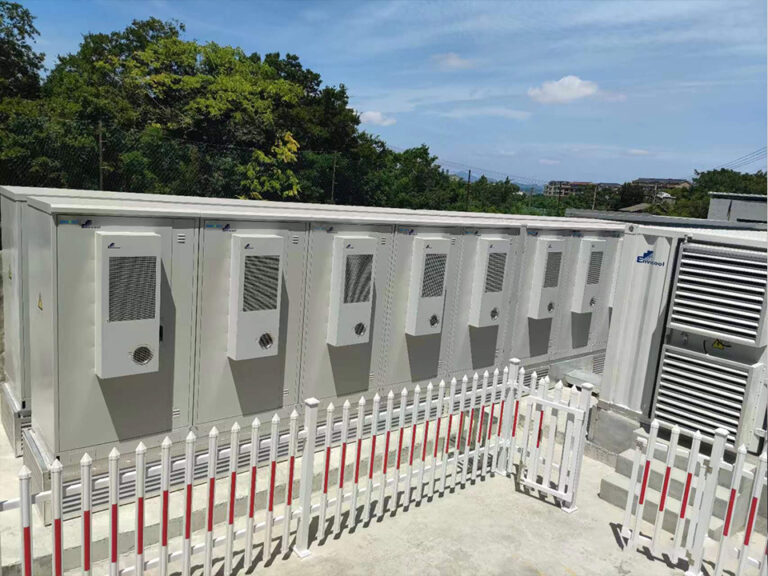
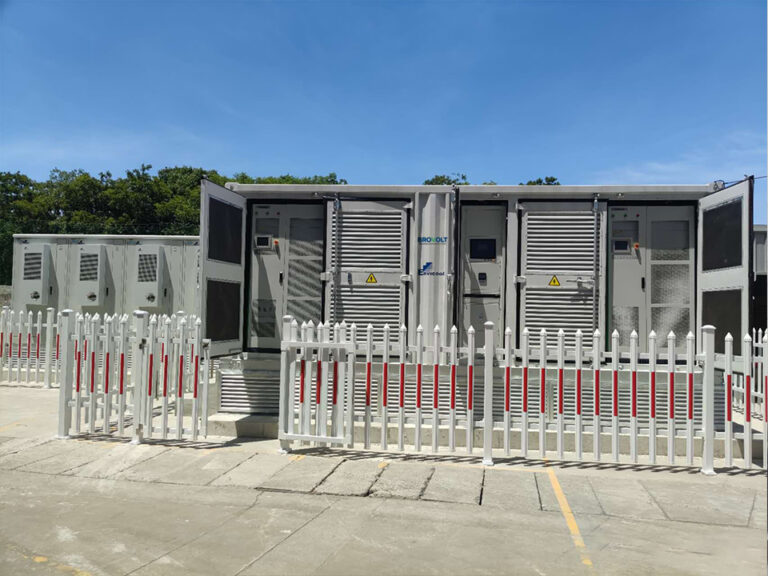
The very same warning applies a lot more highly to a containerized commercial and commercial power storage system. A container may incorporate numerous battery strings, PCS blocks, transformers, complementary drives, heating and cooling tools, BMS, EMS, and switchgear. Till the project setup is frozen, the harmonic model is provisionary– not wrong, however provisional.
Capacitors look basic on a one-line layout. Electrically, they are frequency-selective devices.
Capacitive reactance lowers as frequency increases:
[X_C=\ frac 1 ] That means a capacitor financial institution offering considerable resistance at 50 or 60 Hz might supply a very appealing course to harmonic present at 250, 300, 350, or 420 Hz. The result can be elevated capacitor current even when bus-voltage THD shows up acceptable.
NREL’s microgrid style assistance specifies that unfiltered harmonic currents are brought in to power-factor-correction capacitors since their resistance lowers with frequency. Those banks can function as harmonic-current sinks and become strained; the exact same guidance recommends measurement-supported design analysis prior to picking passive or active filters.
The dangerous system is normally one of two kinds:
Identical vibration develops a high network insusceptibility near the resonant frequency. A fairly tiny harmonic current can after that develop a large harmonic voltage.
Collection vibration produces a low-impedance course. Harmonic current can become large with the capacitor, reactor, transformer, or wire even while voltage distortion elsewhere stays stealthily moderate.
A common initial screening price quote is:
[h_r \ approx \ sqrt ] where (hr) is the approximate powerful harmonic order, (S SC) is short-circuit strength, and (Q_C) is capacitor-bank score in compatible units.
Useful? Yes.
Adequate? No.
The formula neglects network topology, wire capacitance, transformer regularity action, multiple financial institutions, load damping, filters, and converter insusceptibility. I utilize it to recognize uncertainty, not to provide a design judgment.
An instance documented in ESIG’s 2024 overview makes the point neatly. Engineers originally believed wind-turbine inverters after inappropriate voltage distortion appeared at a wind ranch. Closer assessment discovered that distortion was greatest when the turbines were de-energized: a 9th-harmonic resonance involving collection agency wires, substation capacitors, transformer saturation, and system unbalance was accountable. Altering the capacitors detuned the network.
The inverter was the noticeable suspect.
It was likewise the wrong suspect.
Industrial Load Harmonics Are Operating-State Issues
“Industrial lots” is not a valuable harmonic model. It is an invoicing category.
The model has to differentiate the real technologies behind the megawatts:
Six-pulse and twelve-pulse variable-frequency drives
Active-front-end drives
DC drives and rectifiers
Uninterruptible power products
Switched-mode power materials
Welding equipment
Arc and induction heaters
Electrolyzers
Electric lorry charging systems
Huge data-processing loads
LED lights
Magnetizing and transformer saturation effects
An ideal six-pulse rectifier is typically associated with particular harmonics of order (h=6k \ pm1), making the 5th and 7th popular, adhered to by the 11th and 13th. Yet area ranges are seldom excellent. Resource resistance, DC-link inductance, shooting imbalance, drive loading, commutation overlap, transformer links, and background voltage distortion adjustment both size and stage angle.
Aggregation matters as well. Harmonic currents from twenty drives do not necessarily include arithmetically. Phase-angle variety can produce termination. Yet presuming best termination is similarly careless.
Modern electronic lots are likewise increasing at a scale that transforms what “commercial” ways. A December 2024 United State Department of Energy report discovered that American information centers eaten about 176 TWh in 2023, representing concerning 4.4% of national electrical energy use, and projected a rise to approximately 6.7%– 12% by 2028. Big UPS-fed and power-electronics-dense centers for that reason are entitled to the very same modeling technique historically reserved for steel mills and chemical plants.
So I do not accept “motor lots” or “electronic load” as final design inputs. I want tools type, pulse number, control topology, packing variety, device count, transformer connection, harmonic range, and– where available– gauged stage angles.
The Minimum Data Establish for a Defensible Power Top Quality Harmonic Study
The research study top quality is capped by the input top quality. No solver can recuperate transformer information that nobody collected.
Called for input
Why it matters
Weak replacement I would certainly challenge
Point of typical combining meaning
Determines where conformity is examined
Utilizing the nearest hassle-free meter
Maximum and minimum utility fault degrees
Moves powerful regularities and adjustments distortion
One “common” short-circuit worth
Transformer resistance, vector group and faucets
Impacts sequence paths, resonance and depletion
Nameplate MVA alone
Cable television and overhead-line geometry
Establishes frequency-dependent resistance, inductance and capacitance
Fundamental-frequency reactance only
Capacitor-bank stage sizes and changing logic
Modifications resonant frequency by operating state
Total mounted kvar
Reactor and filter component tolerances
Determines tuning and detuning
Nominal adjusting regularity
Computer supplier harmonic model or spectra
Represents BESS shot and insusceptibility
Common PWM inverter
VFD, UPS and rectifier spectra
Defines industrial harmonic resources
One combined nonlinear tons
Existing voltage-distortion dimensions
Records utility and neighboring-customer background
Thinking a completely sinusoidal resource
Operating schedules and contingencies
Identifies reputable worst instances
Maximum lots only
Meter class and sampling details
Develops whether measurements are trustworthy
Screenshot from a panel meter
Tools harmonic-duty rankings
Converts distortion right into property risk
Inspecting THD alone
For modular batteries, the distinction in between DC equipment and a/c conversion should remain clear. A 51.2 V 200Ah rack-mounted LiFePO4 energy storage space battery gives 10.24 kWh of nominal DC storage space, while a 51.2 V 100Ah rack-mounted LiFePO4 battery component for ESS gives 5.12 kWh and supports assimilation with a compatible inverter or PCS. Harmonic performance can not be presumed from either battery score; it depends on the connected conversion system and AC network.
How to Do a Harmonic Study Without Tricking Yourself
A defensible operations is iterative. Dimension educates modeling; modeling identifies missing measurements; mitigation is after that examined versus both.
1. Define the conformity border
Identify the point of typical coupling, tools terminals, inner buses, and legal dimension points.
Do this very first. Or else, the group may invest weeks demonstrating compliance at a bus where no one is required to comply.
2. Conduct standard dimensions
Record voltage and current waveforms before linking the brand-new BESS, capacitor financial institution, or commercial load.
Dimensions should cover:
Normal manufacturing
Light-load durations
Capacitor switching
Large drive starts or procedure modifications
Utility-source transfers
Weekday and weekend break operation
Private harmonic size and phase
Voltage and existing unbalance
Short-duration occasions where sensible
A single 15-minute picture is evidence of one 15-minute period. Nothing a lot more.
3. Verify the fundamental-frequency version
Before analyzing the 25th or 50th harmonic, confirm that the load-flow design recreates measured 50 or 60 Hz voltage, present, power element, transformer loading, and reactive-power flow.
Negative basic versions make advanced harmonic plots look authoritative while staying wrong.
4. Construct the frequency-dependent network
Represent transformers, wires, expenses lines, generators, energy equivalents, filters, capacitor banks, reactors, and converter user interfaces over the necessary regularity range.
High-frequency damping deserves special attention. ESIG advises that leaving out skin-effect-related resistance and various other frequency-dependent damping from electromagnetic-transient versions can produce unrealistically serious resonance that does not exist in the physical system.
5. Run resistance checks
Do driving-point resistance checks at:
The PCC
BESS PCS terminals
Main switchboards
Capacitor-bank buses
Big nonlinear-load buses
Filter connection points
Also calculate transfer insusceptibility in between significant harmonic resources and impacted buses. A source may be electrically distant at 60 Hz yet snugly coupled at the resonant frequency.
6. Apply sensible harmonic sources
Use vendor-supplied spectra or confirmed dimensions where feasible. Design harmonic size and stage as functions of operating point instead of utilizing one fixed spectrum for every single condition.
For transmission-connected inverter-based sources, impedance or frequency-coupled versions may be required. Straightforward ideal-current-source representations can not record amplification triggered by converter-network interaction.
7. Run a situation matrix
At minimum, incorporate:
Minimum and optimal grid toughness
All capacitor-bank stage combinations
BESS cost, discharge, idle and VAR settings
Complete and partial computer availability
Maximum and minimum industrial manufacturing
Transformer and feeder contingencies
History distortion level of sensitivity
Filter in service and out of service
Expected component tolerances
Future expansion phases
This produces numerous instances. Great.
The point is not to decrease simulation count. The factor is to find the case the plant will ultimately discover on its own.
8. Evaluate compliance and tools responsibility separately
A site can meet PCC distortion limitations while overstressing an inner capacitor bank. It can likewise go beyond a legal limit without offering an immediate equipment risk.
Those are various final thoughts. The report needs to not obscure them.
9. Layout and retest mitigation
Every mitigation gadget changes system insusceptibility. After adding a filter, reactor, transformer, or capacitor alteration, repeat the full circumstance matrix.
Never ever test the filter just under the situation that warranted purchasing it.
10. Verify during commissioning
Step the mounted system in the exact same operating states utilized in the model. Contrast harmonic spectra, resonant habits, capacitor present, and filter efficiency.
A big inequality is not an aesthetic coverage issue. It implies the assumptions, dimensions, equipment setup, or version require modification.
IEEE 519 and IEEE 2800: The Restrictions Are Not a Universal “5% Guideline”
IEEE 519-2022 develops harmonic-control objectives for systems consisting of linear and nonlinear tons. Its steady-state voltage and existing distortion restrictions use at the user’s factor of usual coupling, not instantly at every inner bus or individual equipment terminal.
Existing distortion likewise can not be lowered to one universal THDi percentage. IEEE 519 assesses current restrictions using total demand distortion and the relationship in between offered short-circuit current and optimal demand-load current. A weak PCC and a solid PCC do not receive similar present limits.
For transmission and sub-transmission projects, IEEE 2800-2022 develops minimum interconnection and performance requirements for inverter-based resources, consisting of power top quality. IEEE technological support associated with the conventional suggests harmonic-impact examination for transmission-connected IBR tasks.
My guideline is basic: recognize every relevant need prior to modeling.
That may include:
IEEE demands
Utility interconnection standards
Grid-code requirements
Tools maker limits
Project agreements
Insurance policy problems
Owner-specific power-quality requirements
Passing one standard does not automatically satisfy the various other 5.
Which Harmonic Mitigation Approach Is In Fact Finest?
There is no universally ideal harmonic filter for industrial power systems.
There is just the most effective action to a confirmed system.
Mitigation approach
Finest suited to
Main advantage
Key threat
Detuned capacitor bank
Power-factor modification where vibration should be shifted
Combines kvar support with vibration control
Activator home heating and wrong detuning point
Single-tuned passive filter
Secure, dominant harmonic orders
Reliable high-current absorption
Develops nearby resonances
High-pass filter
Broad higher-frequency distortion
Larger frequency protection
Fundamental losses and added capacitance
Energetic harmonic filter
Variable nonlinear lots and altering ranges
Dynamic compensation
Current-rating restrictions and control communication
Hybrid active-passive filter
High harmonic existing with altering problems
Shares steady and vibrant burden
More intricate sychronisation
Line activator or DC-link choke
Individual VFD or rectifier mitigation
Easy and neighborhood
Limited reduction
Multi-pulse transformer setup
Big rectifier tons
Terminates chosen particular harmonics
Transformer cost and sensitivity to imbalance
Active-front-end converter
Loads calling for bidirectional or regulated existing
Lower particular distortion when properly tuned
Higher-frequency discharges and control habits
Capacitor-bank resizing or moving
Resonance driven by existing kvar tools
Gets rid of the origin system
May minimize voltage or power-factor assistance
Network reconfiguration
Topology-driven vibration
Can resolve the reason without another filter
Might not be operationally sensible
NREL keeps in mind that active filters can operate as stand-alone devices or be included right into a battery energy storage system. That does not indicate every BESS needs to be offered as a site-wide harmonic filter; available converter present, control data transfer, service warranty limitations, security control, and synchronised active/reactive-power commitments still have to be examined.
And filters bite back.
A tuned branch adds capacitance. That enhancement can create a brand-new resonance below the tuning frequency. Element aging, temperature, making resistances, fell short capacitor elements, and switched arrangements can after that move the vibration again.
“Set up a filter” is not a conclusion.
It is the start of one more research case.
The Research Failures I Would Certainly Obstacle in a Technical Review
Thinking the utility source is completely sinusoidal
Background distortion exists. The new BESS might amplify it as opposed to produce it.
Utilizing one utility short-circuit level
Resonance frequently intensifies under minimal grid strength, but optimal toughness can develop different current-duty problems. Both matter.
Modeling capacitor banks as one taken care of kvar block
Automatic banks switch in phases. Each legitimate stage combination produces a different network.
Dealing with all drives as similar existing resources
Billing, still operation, reactive-power assistance, decreased PCS availability, and control-mode transitions may generate various outcomes.
Overlooking converter insusceptibility
An inverter can enhance ambient distortion with its frequency-dependent insusceptibility even when its straight harmonic injection is reduced. ESIG determines this boosting mechanism as a material worry for inverter-based plants.
Leaving out frequency-dependent damping
This can generate spectacular vibration stories that vanish when realistic cord, transformer, and line resistance are consisted of.
Choosing filters by least expensive resources expense
An affordable filter that transforms reactive-power flow, overloads throughout a contingency, or creates a close-by resonance is not affordable. It is postponed rework.
Coverage THD without private harmonics
2 buses can have the exact same THD and entirely different risks. Capacitor responsibility, transformer home heating, control interference, and vibration are frequency-specific.
Hiding uncertainty
Supplier versions may be not available prior to procurement. Future lots might be speculative. Utility insusceptibility might be provided as a range.
State those unpredictabilities. Then run level of sensitivities.
False precision is worse than a sincere array.
What the Final Harmonic Distortion Evaluation Should Deliver
A specialist record should consist of:
Range and suitable requirements
Defined PCC and interior assessment buses
Source-data register
Dimension campaign summary
Design presumptions and restrictions
Utility-impedance situations
Harmonic-source models
Frequency-scan plots
Harmonic voltage and current ranges
Compliance tables
Capacitor, transformer, cable and filter duties
Typical and contingency results
Background-distortion level of sensitivity
Mitigation choices
Residual dangers
Commissioning test plan
Indigenous model-file register
Clear responsibilities for unsettled supplier data
I also anticipate an exec solution to three questions: Will the job comply? Will the tools make it through? What must transform before energization?
Every little thing else sustains those responses.
Frequently Asked Inquiries
What is power system harmonic analysis?
A power system harmonic analysis is a design research study that evaluates voltage and existing distortion, recognizes powerful frequencies and accountable sources, tests compliance at the factor of usual combining, and predicts whether transformers, cords, capacitor financial institutions, converters, relays, or filters deal with undesirable electrical or thermal stress.
It usually integrates area measurements, frequency-dependent network modeling, harmonic-source information, impedance scans, scenario analysis, and post-installation recognition.
Exactly how is BESS harmonic evaluation various from an average load research?
BESS harmonic analysis is the frequency-domain and, when required, electromagnetic-transient analysis of exactly how a battery power-conversion system infuses, takes in, or magnifies distortion while billing, discharging, idling, supplying responsive power, or altering control setting under different grid-strength and equipment-availability problems.
Unlike a repaired nonlinear lots, a BESS is bidirectional and highly managed. Its operating point and frequency-dependent resistance can alter throughout the day.
Can capacitor financial institutions cause harmonic vibration?
Capacitor bank harmonic resonance is the amplification of harmonic voltage or current that takes place when system inductance and mounted capacitance develop a natural regularity near an existing harmonic resource, permitting reasonably modest background distortion to produce high present, overvoltage, fuse procedure, overheating, or equipment failure.
Detuned activators, bank resizing, moving, staged-control changes, easy filters, energetic filters, or network reconfiguration may fix the issue, however each option must be inspected across all credible switching states.
How do you perform a harmonic research study?
A defensible harmonic study is done by specifying the PCC and restrictions, gathering field measurements and supplier information, constructing a frequency-dependent network model, scanning insusceptibility, applying sensible harmonic spectra, testing operating circumstances, inspecting tools obligations, creating reduction, and confirming the final model versus measured habits.
The sequence issues. Picking a filter prior to determining the resonance and resource is usually a costly guess.
What are the best harmonic filters for commercial power systems?
The very best harmonic filter for a commercial power system is the tool or combination that removes the recognized distortion without producing a brand-new vibration, going against reactive-power demands, straining throughout backups, or relying on a control reaction that can not continue to be secure across the site’s operating range.
Steady leading orders might prefer tuned easy filters. Rapidly differing loads might validate active filters. High-current sites frequently need hybrid solutions.
When should a commercial center commission a power high quality harmonic research study?
An industrial center ought to commission a harmonic research study before including large VFDs, rectifiers, UPS systems, arc heaters, capacitor financial institutions, solar inverters, or BESS equipment, and once more when unexplained overheating, hassle trips, capacitor failings, relay misoperation, or waveform measurements indicate that the existing network version no longer stands for the plant.
The most inexpensive timing is before procurement. The most expensive timing is after repetitive devices failing.
Specify the Harmonic Research Prior To Buying the Hardware
Do not await the capacitor merges to operate.
Define the PCC, obtain the computer and nonlinear-load data, gauge the existing distortion, model every trustworthy switching state, and make harmonic approval part of procurement– not an argument carried out after energization.
For a BESS or commercial storage space project, send the system power, energy, voltage, transformer setup, capacitor-bank information, nonlinear-load inventory, energy fault degrees, and desired operating settings for a project-specific harmonic analysis and mitigation strategy.